
 Image 1 of 4
 Image 2 of 4
 Image 3 of 4
 Image 4 of 4
Featured Products
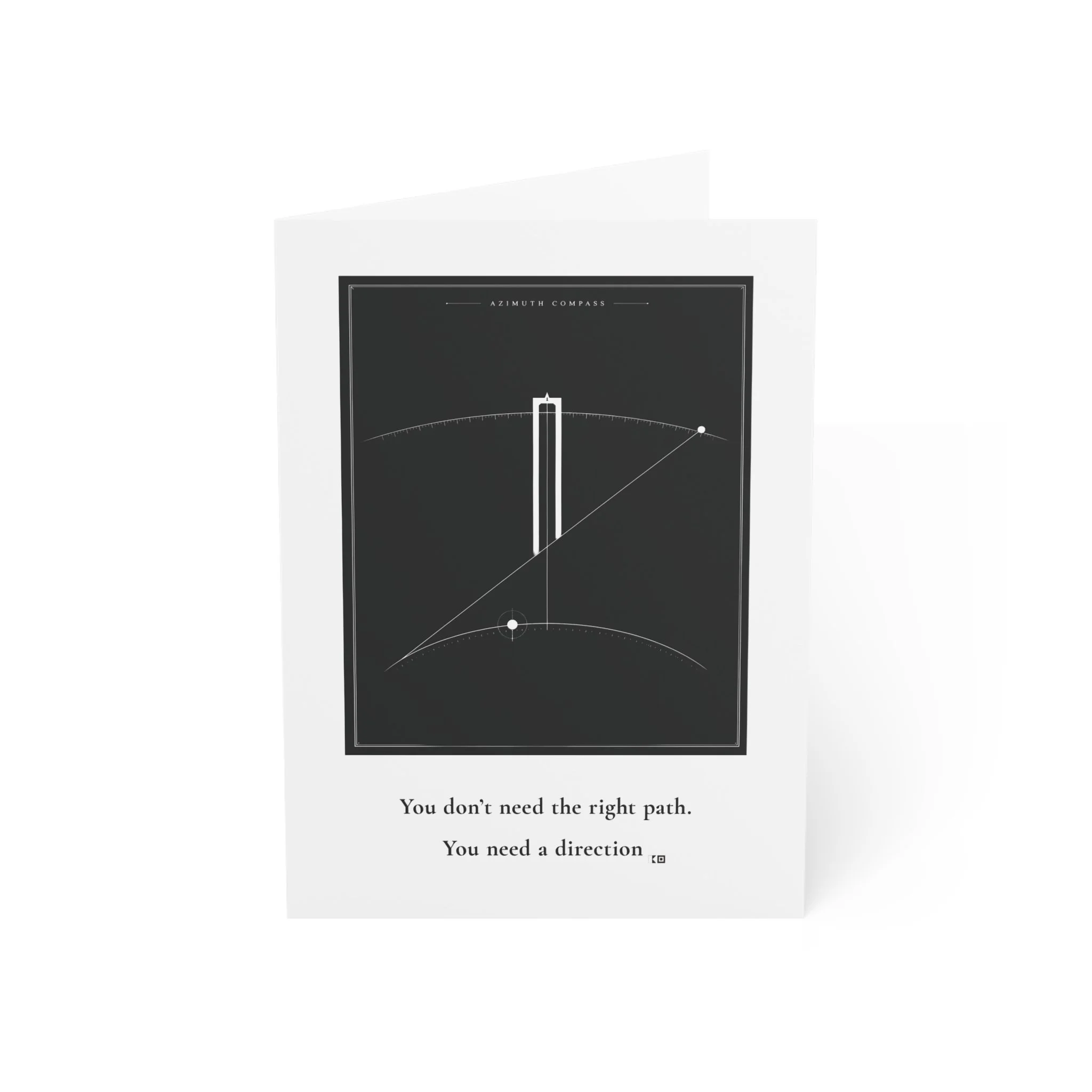
There is a technique used by ground search-and-rescue teams looking for downed aircraft in dense terrain. You cannot always see where you are going. You cannot always see the whole route. What you can do is take a bearing—a single measured direction from where you stand toward something steady enough to move by.
That is an azimuth.
It does not promise ease. It does not clear the terrain, fix the weather, or guarantee arrival. It simply answers one question at a time: which way.
The physicist behind this card learned that technique with the Civil Air Patrol, U.S. Air Force Auxiliary. She also learned it the longer way—the kind that does not appear in any manual. Knowing exactly what she wanted to be at six years old. Not having the conventional path open for her. Starting over at community college. Rebuilding. Continuing. Arriving at Wright-Patterson Air Force Base at 25, working on NASA projects, having taken a route no one would have drawn for her.
She did not need the right path. She needed a direction.
Azimuth Compassis a card for anyone in that position. The graduate whose route looks nothing like expected. The person starting over. The one who has been moving without a map and needs to be reminded that a bearing—held steadily, recalibrated honestly—is enough to begin.
It does not offer fantasy. It offers orientation.
Product Features:
5 × 7 inches. Printed on card stock. European or American size options available. Includes matching envelope
Part of the Signal & Post series by A-L.C.L. Wagenknecht.
Care instructions
Gently wipe with a soft, clean, dry cloth, moving from the center outward
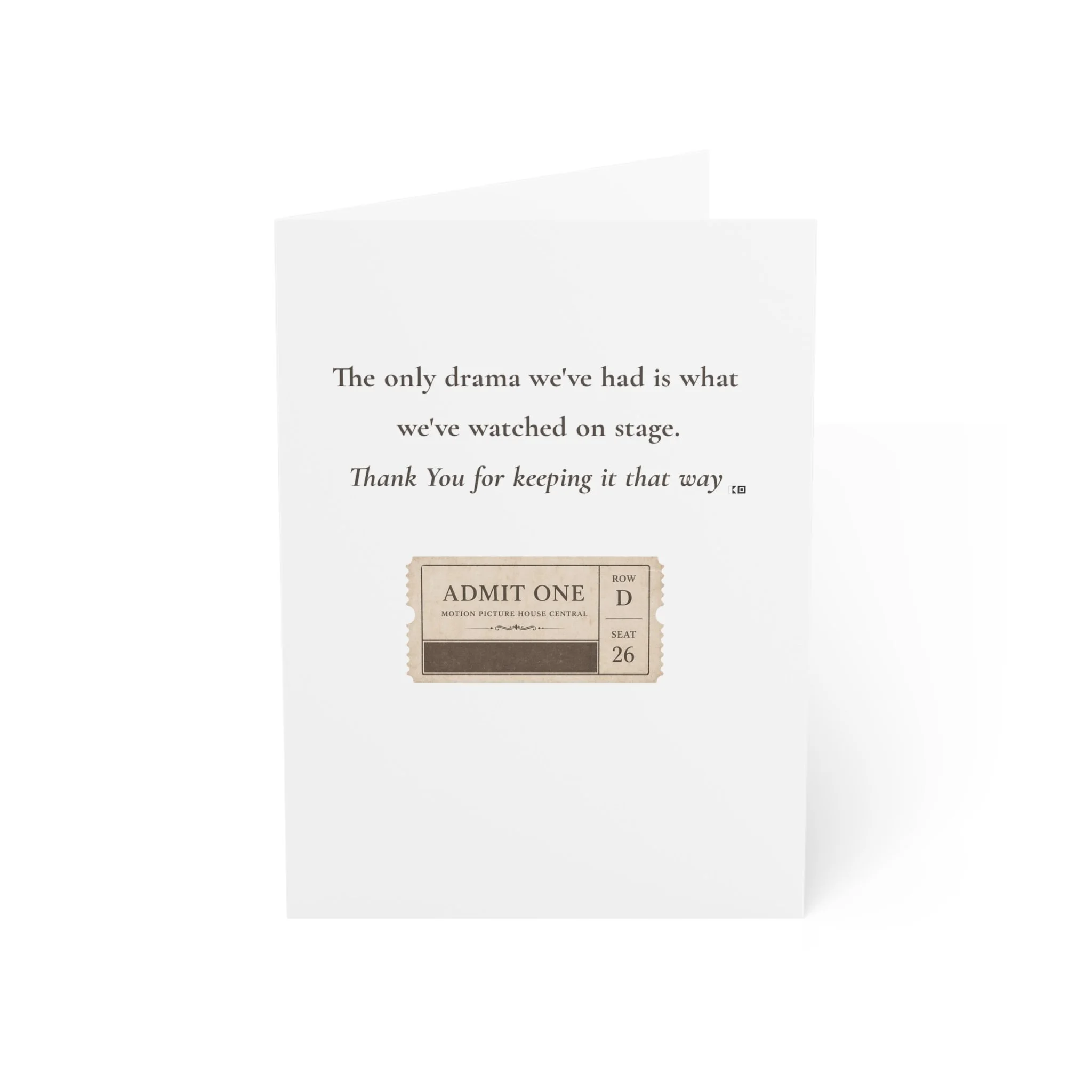
Leave the Drama to the Theatre
There is a difference between conflict and drama—and not everyone knows it.
Conflict is what happens when two people care enough to disagree. It is uncomfortable, sometimes painful, and entirely necessary. It gets spoken. It gets worked through. It leaves something better behind it, or at least something honest.
Drama is something else. Drama performs. It escalates what could be addressed into something that needs an audience. It turns a disagreement into a production—and productions, by design, are not about resolution. They are about effect.
The relationships worth keeping are the ones that know the difference.
Not because they are without friction. Every relationship of any real depth has friction. But because when something needs to be said, it gets said—directly, between the people it involves—and then it is done. No spectacle. No aftermath designed to be felt for longer than the thing itself deserved.
Leave the Drama to the Theatre is a card for that kind of relationship. For the partner, the friend, the colleague who handles things. Who does not perform conflict. Who stays in the room and works it out, and then moves on.
The only drama we've had is what we've watched on stage. Thank You for keeping it that way.
Product Features:
5 × 7 inches. Printed on card stock. European or American size options available. Includes matching envelope
Part of the Signal & Post series by A-L.C.L. Wagenknecht.
Care instructions
Gently wipe with a soft, clean, dry cloth, moving from the center outward
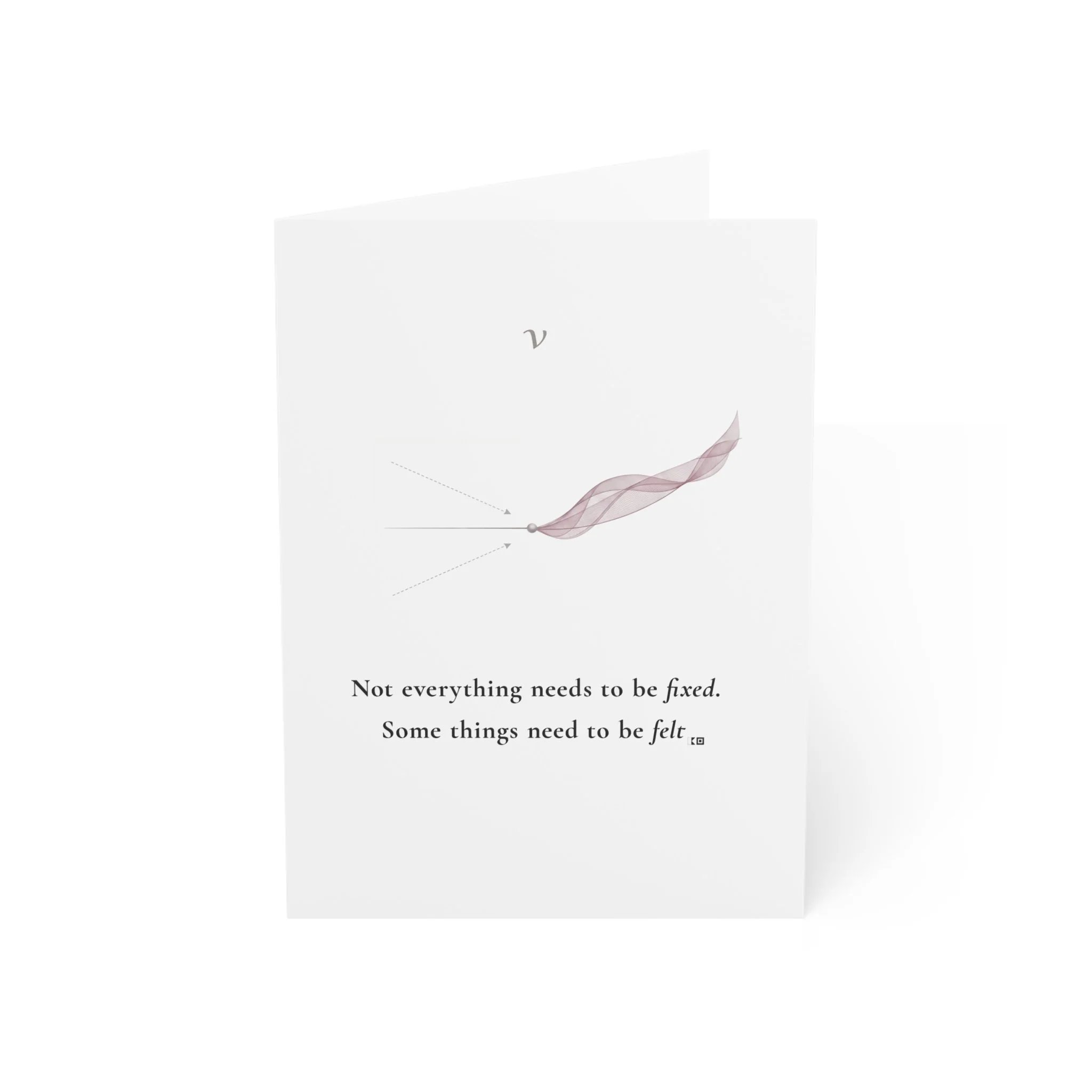
There is a certain kind of person who, when something hurts, immediately wants to understand the mechanism. Name it. Model it. Fix it.
The creator of Signal & Post was that person—and she valued it. Precision matters. Diagnosis matters. But over time, she kept encountering people who had made fixing into a reflex: reaching for a solution not because one was available, but because sitting with the pain was harder. Because feeling it, fully, without an exit, required something that solving never did.
She also kept filling her notebooks with ribbons.
Not because she couldn't decide between the two—feeling and solving, softness and structure—but because she didn't believe they were actually opposites. Her physics diagrams had elegance. Her ribbons had geometry. A Möbius strip is both: continuous, precise, and quietly strange in a way that resists easy explanation.
At the center of this card is a pearl. It comes from somewhere personal—the Philippines has been called the “Pearl of the Orient Seas” for centuries. But a pearl is also a physics problem. Pressure, sustained. Irritation, layered into luster. Not fixed. Not removed. Transformed.
The Forces of Feelings is a card for the moments that don't yield to correction. The ones that ask something different: to be witnessed, carried, and felt rather than resolved. It was made for the person in front of something they cannot engineer their way through—and for the one who wants to sit with them in it, without pretending otherwise.
Not everything needs to be fixed.
Some things need to be felt.
Product Features:
5 × 7 inches. Printed on card stock. European or American size options available. Includes matching envelope
Part of the Signal & Post series by A-L.C.L. Wagenknecht.
Care instructions
Gently wipe with a soft, clean, dry cloth, moving from the center outward
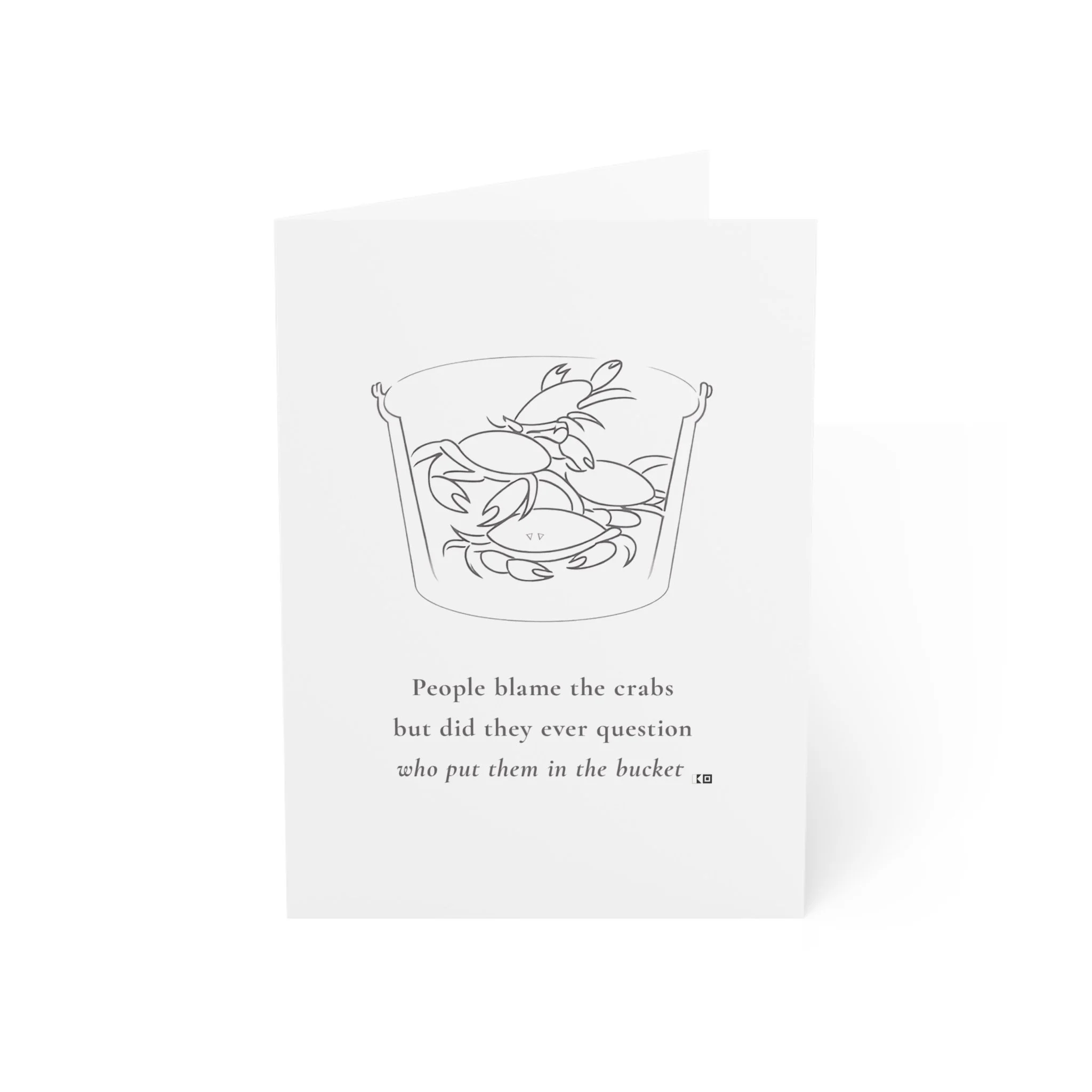
Crab Mentality
The phrase gets used constantly. Someone succeeds, someone else undermines them—crab mentality, people say, nodding knowingly. The crabs pull each other down. That's just what they do. Allegedly.
Here is what those people have never considered: who put them in the bucket.
Crabs in a bucket are not in their habitat. They are in a container, without water, without shelter, without the conditions that make normal behavior possible. They are stressed, disorientated, and are running out of time. What looks like sabotage is what any living creature does when it has been placed in a system designed—whether by intention or indifference—to produce exactly that outcome.
The researcher behind this card has spent years observing hermit crabs in proper conditions. What she found was not competition. Not cruelty. Calm. Coexistence. Creatures capable of extraordinary patience—particularly during molting, when they are at their most vulnerable—when their environment actually supports them.
The behavior changes. Because the bucket was never the point.
Who Put Them in the Bucket? is a card for anyone who has been blamed for reacting to a system rather than credited for surviving one. It is also for anyone tired of a metaphor that has always asked the wrong question.
A purchase supports the Wagenknecht Society for Marine Conservation Inc.—conservation centered on observation, environment design, and the ethical study of species too often misread.
Product Features:
5 × 7 inches. Printed on card stock. European or American size options available. Includes matching envelope
Part of the Signal & Post series by A-L.C.L. Wagenknecht.
Care instructions
Gently wipe with a soft, clean, dry cloth, moving from the center outward
Visit www.wsmci.org to learn more about the Wagenknecht Society for Marine Conservation Inc.